
Walk into the headquarters of any serious company in Riyadh, Jeddah, or Al Khobar right now, and you’ll notice something that wasn’t quite as common five years ago. Art. Big, deliberate, considered art — in reception areas, atrium floors, entrance corridors. Not a decorative vase. Not a framed print. An actual sculpture that someone clearly spent real money and real thought on.
This isn’t coincidence. Saudi Arabia is in the middle of a genuine cultural shift — Vision 2030 has pushed arts, culture, and creative identity from the margins to the center of how the Kingdom presents itself, both nationally and internationally. And that’s trickling down to how companies think about their own spaces. The lobby is no longer just a waiting area. It’s a brand statement. It’s the first thing a client, a partner, or a new hire encounters before they’ve shaken a single hand.
So if you’re responsible for fitting out a corporate office lobby in KSA — or you’re advising someone who is — this guide is for you. Not the theoretical, generic version of this topic. The practical, KSA-specific version.
 Why the Lobby Matters More Than You Think
I know. It sounds obvious. Of course the lobby matters.
But here’s the thing — most companies treat lobby art as an afterthought. They budget carefully for the boardroom AV setup, the ergonomic chairs, the branded wayfinding signage… and then with two weeks until opening, someone says “we should put something in the entrance.” And they scramble.
That’s backwards. The lobby is the first physical experience someone has of your organization. Before anyone’s explained your values, before the pitch deck, before the guided tour — they’ve already formed an impression. And a sculpture in a lobby, done well, communicates something that no printed brand guideline can.
What does it say? Depends entirely on what you choose.
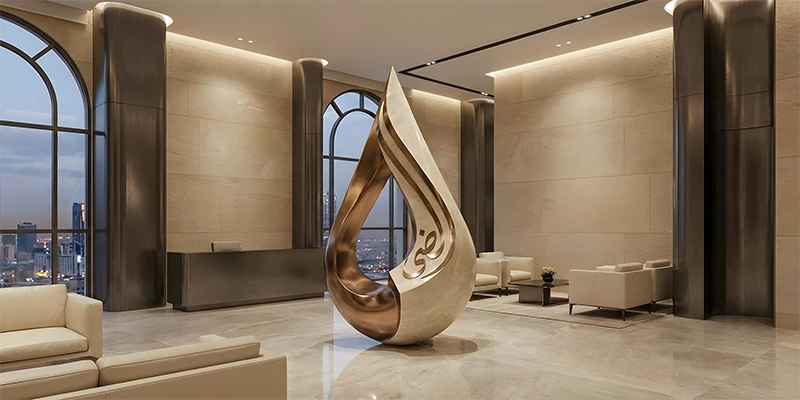
A polished stainless abstract form says: modern, international, confidence in design. A hand-cast bronze piece with cultural motifs says: rooted, established, proud of heritage. A large-scale geometric installation says: bold, architectural, we think at scale. And a poorly chosen generic piece from a catalog says… well. You know what it says.
 What’s Different About Buying Corporate Art in KSA
If you’ve bought sculpture for offices in Europe or the US before, some things translate. A lot of things don’t.
Cultural sensitivities are real and specific. Saudi Arabia has guidelines around imagery in public and commercial spaces — figurative art depicting the human form, particularly faces, requires careful consideration. This doesn’t mean it’s impossible, but it means you need to think about it intentionally, and ideally work with a supplier or artist who understands the local context. Abstract forms, geometric patterns, calligraphy-based work, and nature-inspired sculpture are generally safer territory and often more visually interesting anyway.
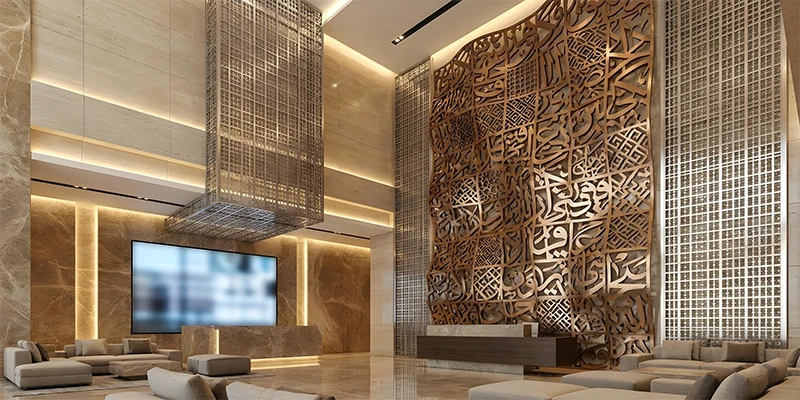
Arabic calligraphy and Islamic geometric design are genuinely powerful. Not as a “safe option” — as an aesthetic choice that can be extraordinary. Some of the most impactful corporate lobby sculptures I’ve seen in the Gulf lean fully into this language. A large-scale bronze wall installation of Quranic calligraphy in a financial institution’s lobby. A geometric lattice structure in stainless steel referencing traditional mashrabiya patterns. These aren’t compromises. They’re strong design choices that also happen to be culturally resonant.
The Vision 2030 context changes the cultural conversation. Saudi Arabia is actively investing in contemporary art and creative identity. Institutions like Ithra, the Misk Art Institute, and the Diriyah art district are elevating a new generation of Saudi and regional artists. Commissioning from this space isn’t just culturally appropriate — it’s increasingly seen as a marker of a forward-thinking company.
The climate affects your material choice. If your lobby has any semi-outdoor elements — an atrium, an uncovered entrance canopy, a courtyard space — you need to factor in heat, UV, and potentially humidity (especially coastal locations). This isn’t minor. It affects what materials are viable, what finishes will hold up, and what your maintenance commitment needs to be. (More on materials below.)
 Defining What You Actually Need
Before you talk to a single supplier or sculptor, get clear on these questions. Seriously — write them down.
What’s the scale of the space? A sculpture that looks significant in a 4-metre ceiling reception will disappear in a double-height atrium. And vice versa — something commissioned for a grand entrance can overwhelm a smaller, more intimate lobby. Measurements matter. So does ceiling height, natural light direction, and how much wall vs. floor space you’re working with.
What’s the primary function? A sculpture that’s meant to be photographed and shared on social media has different requirements than one meant to be experienced slowly, up close, over years. A signature piece for a new HQ opening is different from background art for a serviced office lobby. Know what job the piece is actually doing.
Who is the audience? Government clients have different sensibilities than tech startups. A law firm’s lobby serves a different visitor than a hospitality company’s. Regional clients may respond differently to abstraction than international visitors. None of this should dictate your choice entirely — but it should inform it.
What’s the genuine budget? Not the aspirational number. The real one. Corporate sculpture in KSA can range from SAR 15,000 for a quality production piece to SAR 500,000+ for a bespoke commissioned work by an established artist. The range is huge. Knowing where you actually sit stops you wasting time.
How much maintenance are you willing to commit to? Bronze is extraordinary but needs care. Stainless steel is more forgiving. Resin indoors is fine. Some materials degrade in KSA conditions if neglected. Be honest about your facilities management capacity.
 Materials: The Practical Reality for KSA Lobbies
I covered this in depth in a separate piece on bronze vs. resin vs. stainless steel for Saudi conditions, but here’s the lobby-specific version.
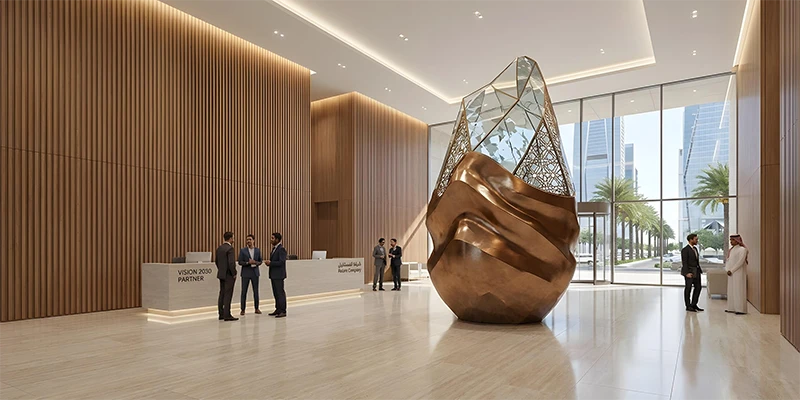
Bronze remains the prestige choice for corporate lobbies. It ages with character, holds extraordinary detail, and communicates permanence in a way no other material quite does. For an interior lobby with climate control, it’s excellent. The maintenance requirement — periodic waxing, cleaning — is manageable in an office environment. For pieces near entrance doors that open to the outside, or in atrium spaces with natural ventilation, you need to think more carefully about salt air (coastal offices especially) and humidity swings.
Stainless steel (316 marine grade) is my personal preference for a lot of corporate lobby applications. It handles the climate, it’s durable in high-traffic areas, and the range of finishes is genuinely impressive — mirror-polished, brushed, powder-coated, patinated. Large stainless installations photograph beautifully, which matters in an era where your lobby ends up on LinkedIn constantly. Downside: it shows fingerprints, especially in busy lobbies. Mirror finishes in particular need regular wiping in dusty environments.
Resin and fiberglass composites work well for interior-only lobby pieces, especially when weight is a constraint (upper-floor lobbies, suspended installations) or when the design requires organic forms that are difficult to achieve in metal. High-quality UV-stable resins hold up fine indoors. Just don’t put them anywhere with significant direct sunlight — the UV degradation over time is real.
Stone and composite stone deserve a mention. Marble, limestone, and engineered stone have a long history in Arab architecture and feel immediately at home in a Saudi corporate context. They’re heavy — structural requirements need to be factored in early — and they’re cold-finish rather than dynamic, but for certain styles of lobby (traditional, heritage-influenced, luxury hospitality brands) they’re hard to beat.
Mixed media and site-specific installations are increasingly common in higher-budget projects. Steel armatures with stone elements, bronze with integrated lighting, stainless with hand-applied patina finishes. These tend to be commissioned pieces, and they require more coordination — but the results are often the most distinctive.
This is the choice that shapes everything else. Are you buying an existing piece, or commissioning something new?
Both are legitimate. They’re just different.
Buying an existing piece (from a gallery, supplier, or artist’s back catalog) is faster, lower risk, and usually cheaper. You can see exactly what you’re getting before you commit. The limitation is that you’re choosing from what exists, not what could exist for your specific space and brand.
Commissioning a bespoke work is slower, more involved, and more expensive — but it gives you something no one else has. A piece made specifically for your lobby dimensions, your brand values, your cultural context. Done well, it becomes genuinely iconic. Done badly (wrong brief, wrong artist, rushed timeline), it’s an expensive lesson.
For most corporate lobbies, the sweet spot is somewhere in between: finding an artist or studio whose existing aesthetic aligns with what you want, then working with them to adapt or create something within that language for your specific space. Not a full blank-canvas commission, but not purely off-the-shelf either.
A note on Saudi and regional artists. Given where the Kingdom’s art scene is right now — genuinely exciting, with a generation of serious contemporary Saudi artists getting international recognition — there’s a strong case for commissioning locally. Not because of any obligation, but because the work is often excellent, the cultural fluency is built in, and frankly… a Saudi artist’s piece in a Saudi company’s headquarters tells a different story than an imported catalog item. It’s worth exploring.
Here’s how I’d approach this if I were doing it from scratch.
Step 1: Brief the space, not just the art. Before you talk to anyone, document your lobby properly. Dimensions, ceiling height, floor material, natural light sources, foot traffic patterns, proximity to any HVAC or moisture sources. Take photos at different times of day. Know your structural load capacity if you’re considering a heavy piece. This information separates you from 80% of buyers who show up to suppliers without it.
Step 2: Define your visual brief. You don’t need to be an art director. But you need to have a view. Look at reference images — other corporate lobbies, contemporary sculpture, traditional geometric art, anything that resonates. Build a loose mood board. Identify two or three words that describe what you want the piece to feel like: powerful, serene, dynamic, rooted, modern, welcoming, authoritative. That vocabulary becomes your brief.
Step 3: Understand your procurement process early. In KSA, many corporate and government-adjacent entities have procurement requirements — multiple quotes, supplier registration, approval chains. Don’t start commissioning an artist and then discover your finance process requires three competing bids. Know your own process before you make commitments.
Step 4: Evaluate suppliers and artists with specific criteria. Ask for:
Step 5: Build in review stages. For any significant commission, structure the contract around approval points: concept sketch, scale maquette (a small model of the final piece), material samples, and then final delivery. Each stage should require your sign-off before the next begins. This protects both you and the artist.
Step 6: Plan for installation and maintenance from day one. This sounds obvious. It isn’t, apparently, because the number of times installation has been the thing nobody budgeted for… Installation of large sculpture requires specialists, potentially structural engineering sign-off, rigging equipment, surface preparation. Get quotes early. And discuss maintenance before you commit — every material has requirements, and you need a realistic plan for how they’ll be met in your specific environment.
Rough ranges, based on the current market. These are wide because quality varies enormously within each category.
Production sculpture (catalog/gallery purchase, existing pieces): SAR 8,000 – 80,000 depending on size, material, and artist reputation.
Semi-custom work (adapting an existing design to your specifications): SAR 40,000 – 200,000.
Fully bespoke commission from an emerging Saudi/regional artist: SAR 60,000 – 300,000.
Bespoke commission from an established or internationally recognized artist: SAR 250,000 – 1,000,000+.
Large-scale site-specific installation (major HQ, hotel lobby, iconic building): SAR 500,000 – several million. These are projects with their own dedicated budgets and procurement processes.
Installation costs are typically 10–20% on top of the artwork price for standard pieces. Complex or large-scale installations can run higher.
Don’t forget: import duties on artwork, VAT (15% in KSA), art insurance for valuable pieces, and ongoing maintenance costs over the piece’s lifetime.
A few things I see go wrong regularly.
Buying from a general furniture or fit-out supplier without specialist input. They’ll have something. It’ll probably be fine. It won’t be memorable, and it won’t be right for your specific space in the way a considered choice would be.
Rushing the timeline. Quality sculpture — especially commissioned work — takes time. Rushing a sculptor produces mediocre work. Rushing installation produces damage. Build at least 3–6 months into your project timeline for a significant lobby piece. More if it’s a full commission.
Choosing purely by aesthetics in isolation. A piece that looks extraordinary in a supplier’s white-walled studio may feel completely wrong in your warm-toned marble lobby. Always, always look at reference images or mockups of the piece in the actual space before committing.
Ignoring maintenance reality. The most common way corporate sculpture looks bad isn’t poor initial choice — it’s neglect. An untreated bronze near a coastal entrance oxidizes unevenly. A polished stainless piece in a high-traffic lobby accumulates fingerprints and surface scratches. Know what you’re signing up for.
Playing it too safe. The point of a significant lobby piece is that it makes an impression. A timid, inoffensive, universally acceptable sculpture is expensive beige. Have a perspective. Make a choice.
Corporate sculpture in KSA right now exists in an interesting moment. The market is genuinely expanding — more companies treating it seriously, more local artists producing relevant work, more suppliers with actual Gulf-climate expertise. And with Vision 2030 pushing cultural investment up the agenda at a national level, the conversation about what goes on corporate walls — and floors, and entrances — has changed.
The companies getting this right aren’t necessarily the ones spending the most. They’re the ones treating the lobby sculpture decision with the same seriousness they’d give a brand identity project. Briefing it properly. Involving the right expertise. Thinking about what the piece communicates, not just what it looks like in isolation.
That’s the whole thing, honestly. Treat it like a considered decision, and you’ll make a good one.